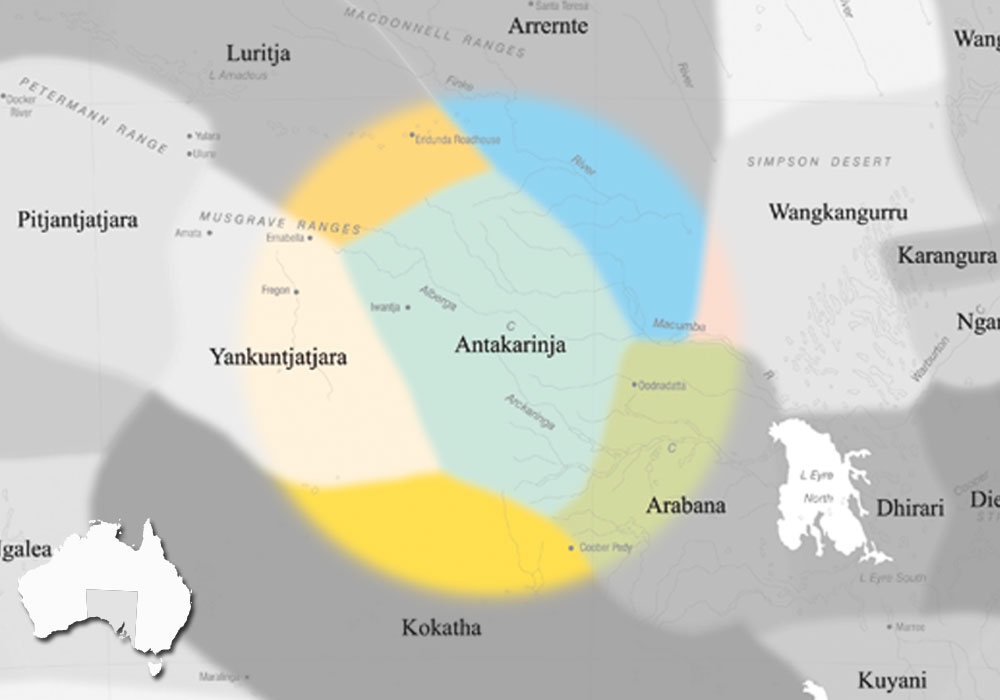
Antikirinya is a part of the Western Desert language group. The Western Desert encompasses a large expanse of land in the centre of the country, and traverses the state borders of Western Australia, South Australia, and the Northern Territory. Antikirinya has traditionally been associated with the north of South Australia. Today, Antikirinya people live in many places across South Australia, including Coober Pedy and Oodnadatta. Many people who formerly identified as Antikirinya now identify as Yankunytjatjara.
Antikirinya man Ingkama Bobby Brown has worked closely with linguist Petter Naessan on a book called ‘Irritja – The Past: Antikirinya History from Ingomar Station and Beyond’ (2012). In this book, Ingkama Bobby Brown talks about growing up at Ingomar Station, the foods and animals you can find on the land there, and about the language.
AIATSIS id : C.05
VARIATIONS
Aldolinga (i.e., Westerners), Alinjerra, Aluna (language name of the southern groups who speak like the Kokatha), Andagarindja, Andagarinja, Andagarinya, Andagerinja, Andagirinja, Andakirinja, Andayarinja, Andegilliga, Andekarinja, Andekerinja (Aranda pronunciation), Andergerebenha, Andgari, Andigari, Andigarina, Andigarinya, Andigerinya, Andigerri, Andigidini, Andigiri, Andigirinji, Andigiriny, Andigirinya, Andingari, Andingiri, Andjirigna, Andjirlingna, Andongerry, Andrgrinji, Anjirigna, Ankuntjatjara, Antakarinja, Antakarinya (used by SIL), Antakerinya, Antakerrinya, Antakirinja, Antegarina, Antegarinya, Antekarinja, Antekarinya, Antekerrepinhe, Anterrikanya, Antigari, Antigerinya, Antikiri, Antikirinya (used by AIATSIS), Antikirrinya, Antin-gari, Antingerrie, Kadjilaranda (group name north of eastern Everard Ranges), Maduntara, Madutara, Mbenderinga, Ngonde, Njuntundjara (name applied by Yankunytjatjara/Jangkundjara), Tangara, Untergerrie, Unterrgerrie, Walarangunja (group name in eastern part of Everard Ranges), Walarenunga, Yandairunga, Yendakarangu.
DISCLAIMER:
The above map is based upon the Horton Indigenous Map of Australia © Aboriginal Studies Press, AIATSIS, and Auslig/Sinclair, Knight, Merz, 1996. The full map is available on the AIATSIS website. The locations of the languages of SA, as stated on the this website are not intended for Land Claim use, and are an approximate guide only. Individual language project locations are based on information from publicly available MILR (ILS) documents.
REFERENCE AND SOURCE ARCHIVE
ANON. n.d. Andagarinja song series. AIATSIS Field tape number(s): CM/70/1-33. []
ANON. 1969. Andagarinja/English word list. Adelaide, SA: University of Adelaide. [[Annotation: Contains some inappropriate terms. Treat with caution.] ]
ANON. 1969. Antikiri: Oodnadatta area, South Australia [. [Antikirinya wordlists, verb suffixes and sentence types.] [AIATSIS print collection.]]
ANON. 2000. Antikirinja Social History Project: sound recording. Interviewer: Sue Anderson; translator: Bobby Brown. Recorded between May - July 2000. [[This material is available at the State Library of South Australia. Written permission required - apply to State Library for details.]]
BERNDT, Catherine H. (Catherine Helen), (1918-1994). 1965. Women and the secret life. [In Berndt, R.; Berndt, C. - Aboriginal man in Australia: pp 238-282 [Brief song texts with translation.]]
BERNDT, Ronald M. (Ronald Murray), (1916-1990). 1942-45. A Preliminary report of field work in the Ooldea region, Western South Australia. Oceania. 1942 [v. 13, no.2, pp.[143]169; 1942 v.13, no.3, pp. [243]-280; 1942: v.13, no.4, pp. 362-375; 1943 v.14, no.1, pp.[30]-66; 1943 v.14, no.3, pp.[220]-249; 1943 v.14, no.4, pp.[338]-358; 1944 v.15, no.1, pp.[49]-80. [Annotation: These articles contain some language references for the “Ooldea dialect” without specifying the language name. The article in 1942 v.13, no.2 contains some wordlists for totems, kinship and food. The article in 1944 v.15, no.1 is specifically about language. Otherwise words are]
BERNDT, Ronald M. (Ronald Murray). 1952, 1953, 1954. A selection of children’s songs from Ooldea, western South Australia [Mankind 1952: 4,9: pp 364-376; 1953: 4,10: pp 423-434; 1954: 4,12: pp 501-508. [Some song texts with translation.] [This material is available at the State Library of South Australia, Barr Smith and other libraries in Adelaide.]]
BREEN, Gavan. 1967. Wangkumara and Antakirinya language elicitation [AIATSIS sound collection. Archive Tape No.: 00611. Field tape 18.1-18.2. [Performer/Speaker: Cecil Ebsworth, Rosie Naylon; Place recorded: Betoota, Birdsville.]]
BREEN, J.G. n.d. Antikirinya fieldnotes (brief, half-hour tape recording.) [[Location unknown.]]
BROWN, Bobbie. Recording and documenting the language at the time this list was compiled. [[Location unknown.]]
CONDON, H. T. (Herbert Thomas). 1955. Aboriginal bird names - South Australia, pt 1 & 2. South Australian Ornithologist 21,6/7: pp 74-88; 21,8; pp 91-8. [[Annotation: Bird names in Aranda, Pitjantjatjara, Gugada, Antakarinya, Mirning, Wirangu, Yankunytjatjara, Wailbi, Wiljagali, Narangga, Kaurna, Ngadjuri, Bungandidj, Yawarawarga, Potaruwutj, Narrinyeri, Kujani, Yadliyawarra, Parnkala, Warki, Arabana, Dieri, Wangganguru, Ngamini, Nawu, Ngayawung, Nugunu & Ngalea. The wordlists have been taken from various other sources.] [This material is available at the State Library of South Australia and other libraries.]]
DOUGLAS, Wilfrid H. (Wilfrid Henry). Antikiri texts [n.d. wordlist: Unpublished material. Area: Western Desert. [WHD (W.H. Douglas) Collection). AIATSIS print collection.] ]
DOUGLAS, Wilfrid H. (Wilfrid Henry). 1964. An Introduction to the Western Desert language. Revised edition. Sydney: University of Sydney. Oceania Linguistic Monograph no.4. VIEW HERE [[Annotation: Includes comparison of several dialects in the appendix.] [This material is available at the State Library of South Australia and other libraries in Adelaide.]]
ELLIS, Catherine J. (Catherine Joan), (1935-1996). 1964. Tapes (mostly songs) Antakirinja 25 cassettes (approx) [[Also Field notes on tape recordings of Aboriginal songs made in 1962-63. Adelaide, Libraries Board of South Australia.] [This material is available at the State Library of South Australia and also held by AIATSIS. See references below for AIATSIS listings.]]
ELLIS, Catherine J. (Catherine Joan). 1963. Antikirinya songs (many similar items are available in the AIATSIS collection) [AIATSIS sound collection. Archive Tape No.: 00196. Field tapes 14, 17. [Access: Restricted - Ceremonial and gender specific.] [Performer/Speaker: Billy Mungie, Alex Woody, Tommy Campbell, Bob Finke; Place recorded: Port Augusta.] [Annotation: Restricted A]
ELLIS, Catherine J. (Catherine Joan). 1963. Antikirinya songs. AIATSIS sound collection. Archive Tape No.: 00196. Field tapes 14, 17. [[Access: Restricted - Ceremonial and gender specific.] [Performer/Speaker: Billy Mungie, Alex Woody, Tommy Campbell, Bob Finke; Place recorded: Port Augusta.] [Annotation: Restricted Antikirinya men's Bandicoot song series, continued from 00196A.]]
ELLIS, Catherine J. (Catherine Joan). 1963. Antikirinya songs. AIATSIS sound collection. [Archive Tape No.: 00197. Field tapes 13, 10. [Access: Restricted - Ceremonial and gender specific.] [Performer/Speaker: Billy Mungie, Alex Woody, Tommy Campbell, Bob Finke; Place recorded: Port Augusta.] [Annotation: Restricted Antikirinya men's Bandicoot song series, continued from 00196B; may also include songs performed by Tom Bagot, Lame Paddy and George Kemp.]]
ELLIS, Catherine J. (Catherine Joan). 1963. Arrernte Duck song and Antikirinya Emu song. AIATSIS sound collection. [Archive Tape No.: 00200. Field tape 21/M5. [Access: Some restricted material - ceremonial and gender specific.] [Performer/Speaker: Tom Bagot, Tommy Campbell, George King, Teddy French, Tommy Winjin, Jimmy Lang, Paddy Giles, Tom Scorpion. Place recorded: Port Augusta, Warburton.] [Annotation: Conclusion of Arrernte Duck song performed by Tom Bagot and Tommy Campbell, continued from 00199B; Antikirinya restricted men's Emu song from Teebeal.]]
ELLIS, Catherine J. (Catherine Joan). 1963. Antikirinya men's songs. AIATSIS sound collection. [Archive Tape No.: 00200. Field tapes 22/M2, 22/M6. [Access: Restricted - ceremonial and gender specific.] [Performer/Speaker: George King, Teddy French, Tommy Winjin, Jimmy Lang, Paddy Giles, Tom Scorpion. Place recorded: Port Augusta.] [Annotation: Antikirinya restricted men's Emu song from Teebeal, continued from 00200A; Antikirinya restricted men's Euro and Kangaroo song.]]
ELLIS, Catherine J. (Catherine Joan). 1963. Antikirinya men's songs. AIATSIS sound collection. [Archive Tape No.: 00201. Field tapes 23/M6, 24/M7. [Access: Restricted - ceremonial and gender specific.] [Performer/Speaker: George King, Teddy French, Tommy Winjin, Jimmy Lang, Paddy Giles, Tom Scorpion; Place recorded: Port Augusta.] [Annotation: Antikirinya restricted men's Euro and Kangaroo song, continued from 00200B.]]
ELLIS, Catherine J. (Catherine Joan). 1963. Antikirinya songs. AIATSIS sound collection. [Archive Tape No.: 00201. Field tapes 24/M7, 24/21. [Access: Some restricted material - ceremonial and gender specific.] [Performer/Speaker: George King, Teddy French, Tommy Winjin, Jimmy Lang, Paddy Giles, Tom Scorpion, Eileen Thompson, Kitty Trerowan, Maggie Kildy; Place recorded: Port Augusta.] [Annotation: Antikirinya restricted men's Euro and Kangaroo song; Dog song from Eberata sung by Maggie Kildy and Kitty Trerowa.]]
ELLIS, Catherine J. (Catherine Joan). 1963. Antikirinya women's song. AIATSIS sound collection. Archive Tape No.: 00202. Field tapes 25/21; 24. [[Access: Restricted - cermonial and gender specific.] [Performer/Speaker: Eileen Thompson, Kitty Trerowan, Maggie Kildy, Nellie Cromby, Daisy Crombie, Eileen Ortie; Place recorded: Port Augusta.] [Annotation: Antikirinya women sing a restricted Edible Grub song from Erbalpa.]]
ELLIS, Catherine J. (Catherine Joan). 1963. Antikirinya women's song. AIATSIS sound collection. Archive Tape No.: 00202. Field tape 24. [[Access: Restricted - ceremonial and gender specific.] [Performer/Speaker: Eileen Thompson, Kitty Trerowan, Maggie Kildy, Nellie Cromby, Daisy Crombie, Eileen Ortie; Place recorded: Port Augusta.] [Annotation: Antikirinya women sing a restricted Edible Grub song from Erbalpa, continued from 00202A.]]
ELLIS, Catherine J. (Catherine Joan). 1963. Antikirinya women's song. AIATSIS sound collection. Archive Tape No.: 00203. Field tape 27/25. [[Access: Restricted - ceremonial and gender specific.] [Performer/Speaker: Eileen Thompson, Kitty Trerowan, Maggie Kildy, Nellie Cromby, Daisy Crombie, Eileen Ortie; Place recorded: Port Augusta.] [Annotation: Antikirinya women sing a restricted Edible Grub song from Erbalpa, continued from 00202B.]]
ELLIS, Catherine J. (Catherine Joan). 1963. Antikirinya women's song. AIATSIS sound collection. Archive Tape No.: 00203. Field tape 28/26. [[Access: Restricted - ceremonial and gender specific.] [Performer/Speaker: Eileen Thompson, Kitty Trerowan, Maggie Kildy, Nellie Cromby, Daisy Crombie, Eileen Ortie; Place recorded: Port Augusta.] [Annotation: Antikirinya women sing a restricted Edible Grub song from Erbalpa, continued from 00203A.]]
ELLIS, Catherine J. (Catherine Joan). 1963. Antikirinya women's song. AIATSIS sound collection. [Archive Tape No.: 00204. Field tapes 29/26; 27. [Access: Restricted - ceremonial and gender specific.] [Performer/Speaker: Eileen Thompson, Kitty Trerowan, Maggie Kildy, Nellie Cromby, Daisy Crombie, Eileen Ortie; Place recorded: Port Augusta.] [Annotation: Antikirinya women sing a restricted Edible Grub song from Erbalpa.]]
ELLIS, Catherine J. (Catherine Joan). 1963. Antikirinya women's song. AIATSIS sound collection. [Archive Tape No.: 00204. Field tapes 30/27; 30/28. [Access: Restricted - ceremonial and gender specific.] [Performer/Speaker: Eileen Thompson, Kitty Trerowan, Maggie Kildy, Nellie Cromby, Daisy Crombie, Eileen Ortie; Place recorded: Port Augusta.] [Annotation: Antikirinya women sing the final part of the restricted Edible Grup song from Erbalpa, continued from 00204A; brief discussion about the meaning of the Edible Grub song; beginning of a second performance of the Edible Grub song.] ]
ELLIS, Catherine J. (Catherine Joan). 1963. Antikirinya women's song. AIATSIS sound collection. [Archive Tape No.: 00205. Field tape 31/29; 31/30. [Access: Restricted - ceremonial and gender specific.] [Performer/Speaker: Eileen Thompson, Kitty Trerowan, Maggie Kildy, Nellie Cromby, Daisy Crombie, Eileen Ortie; Place recorded: Port Augusta.] [Annotation: Evening performance of the restricted Edible Grub song from Erbalpa, continued from 00204B.]]
ELLIS, Catherine J. (Catherine Joan). 1963. Antikirinya women's song. AIATSIS sound collection. A [rchive Tape No.: 00205. Field tape 32/30; 32/31. [Access: Restricted - ceremonial and gender specific.] [Performer/Speaker: Eileen Thompson, Kitty Trerowan, Maggie Kildy, Nellie Cromby, Daisy Crombie, Eileen Ortie; Place recorded: Port Augusta.] [Annotation: Evening performance of the restricted Edible Grub song from Erbalpa, continued from 00205A.]]
ELLIS, Catherine J. (Catherine Joan). 1963. Antikirinya women's song. AIATSIS sound collection. g from Erbalpa, continued from 00205B.] [Archive Tape No.: 00206. Field tapes 33/31; 33/32. [Access: Restricted - ceremonial and gender specific.] [Performer/Speaker: Eileen Thompson, Kitty Trerowan, Maggie Kildy, Nellie Cromby, Daisy Crombie, Eileen Ortie; Place recorded: Port Augusta.] [Annotation: Evening performance of the restricted Edible Grub son]
ELLIS, Catherine J. (Catherine Joan). 1963. Antikirinya women's song. AIATSIS sound collection. [Archive Tape No.: 00206. Field tapes 34/32; 34/33. [Access: Restricted - ceremonial and gender specific.] [Performer/Speaker: Eileen Thompson, Kitty Trerowan, Maggie Kildy, Nellie Cromby, Daisy Crombie, Eileen Ortie; Place recorded: Port Augusta.] [Annotation: Conclusion to evening performance of the restricted. Edible Grub song from Erbalpa, continued from 00206A.]]
ELLIS, Catherine J. (Catherine Joan). 1963. Antikirinya snake song. AIATSIS sound collection. Archive Tape No.: 00207. Field tapes 35/28; 35/29. [[Access: Restricted - ceremonial and gender specific.] [Performer/Speaker: Eileen Thompson, Kitty Trerowan, Maggie Kildy; Place recorded: Port Augusta.] [Annotation: Kitty Trerowan, Eileen Thompson and Maggie Kildy perform a restricted Antikirinya snake song from Warradurra.]]
ELLIS, Catherine J. (Catherine Joan). 1963. Antikirinya snake song. AIATSIS sound collection. Archive Tape No.: 00207. Field tape 35/29 continued; 36. [[Access: Restricted - ceremonial and gender specific.] [Performer/Speaker: Eileen Thompson, Kitty Trerowan, Maggie Kildy; Place recorded: Port Augusta.] [Annotation: Kitty Trerowan, Eileen Thompson and Maggie Kildy perform a restricted Antikirinya snake song from Warradurra, continued from 00207A.]]
ELLIS, Catherine J. (Catherine Joan). 1963. Antikirinya snake song. AIATSIS sound collection. Archive Tape No.: 00208. Field tape 37/34. [[Access: Restricted - ceremonial and gender specific.] [Performer/Speaker: Eileen Thompson, Kitty Trerowan, Maggie Kildy; Place recorded: Port Augusta.] [Annotation: Kitty Trerowan, Eileen Thompson and Maggie Kildy perform a restricted Antikirinya snake song from Warradurra, continued from 00207B.]]
ELLIS, Catherine J. (Catherine Joan). 1963. Antikirinya Printi song. AIATSIS sound collection. Archive Tape No.: 00208. Field tape 38/35. [[Access: Restricted - ceremonial and gender specific.] [Performer/Speaker: Daisy Cromby, Eileen Thompson, Kitty Trerowan, Maggie Kildy; Place recorded: Port Augusta.] [Annotation: Restricted Antikirinya Printi song from Cumbrara, near Ernabella; Daisy Cromby is the song leader.]]
ELLIS, Catherine J. (Catherine Joan). 1963. Antikirinya Printi song. AIATSIS sound collection. Archive Tape No.: 00209. Field tape 39/36. [[Access: Restricted - ceremonial and gender specific.] [Performer/Speaker: Daisy Cromby, Eileen Thompson, Kitty Trerowan, Maggie Kildy; Place recorded: Port Augusta.] [Annotation: Restricted Antikirinya Printi song from Cumbrara, near Ernabella; Daisy Cromby is the song leader; continued from 00208B.]]
ELLIS, Catherine J. (Catherine Joan). 1963. Antikirinya Printi song. AIATSIS sound collection. Archive Tape No.: 00209. Field tape 39/36 continued; 40; 39/37. [[Access: Restricted - ceremonial and gender specific.] [Performer/Speaker: Daisy Cromby, Eileen Thompson, Kitty Trerowan, Robby Lang; Place recorded: Port Augusta.] [Annotation: Restricted Antikirinya Printi song from Cumbrara, near Ernabella; Daisy Cromby is the song leader; continued from 00209A.]]
ELLIS, Catherine J. (Catherine Joan). 1963. Antikirinya Printi song. AIATSIS sound collection. Archive Tape No.: 00210. Field tape 41/37. [[Access: Restricted - ceremonial and gender specific.] [Performer/Speaker: Daisy Cromby, Eileen Thompson, Kitty Trerowan, Robby Lang; Place recorded: Port Augusta.] [Annotation: Restricted Antikirinya women's Printi song from Cumbrara, near Ernabella; Daisy Cromby is the song leader; continued from 00209B.]]
ELLIS, Catherine J. (Catherine Joan). 1963. Antikirinya Printi song. AIATSIS sound collection. Archive Tape No.: 00210. Field tape 42/38-39. [[Access: Restricted - ceremonial and gender specific.] [Performer/Speaker: Daisy Cromby, Eileen Thompson, Kitty Trerowan, Robby Lang; Place recorded: Port Augusta.] [Annotation: Conclusion of restricted Antikirinya women's Printi song from Cumbrara, near Ernabella; Daisy Cromy is the song leader; continued from 00210A.]]
There are numerous similar items in the AIATSIS sound collection []
GILLEN, F.J. 1903. ‘Moonta, 29th January 1903.’ In ’My dear Spencer’ : the letters of F.J. Gillen to Baldwin Spencer / edited by John Mulvaney; Howard Morphy and Alison Petch. South Melbourne: Hyland House, 1997. [[This material is available at the State Library of South Australia, Barr Smith and other libraries in Adelaide.]]
HALE, Kenneth. 1960. Antikirinya fieldnotes. [[See Parrish, 1980. (op.cit.)]]
HELMS, Richard. 1896. Anthropology. Report of the Elder Scientific Expedition, 1891. Royal Society of South Australia – Transactions 16, pt.3: pp237-332. VIEW HERE [[Annotation: 15 word ‘Andijiringna’ list from Billy Weaver.][This material is available at the State Library of South Australia, Barr Smith and other libraries in Adelaide.]]
HOWITT, A. W. (Alfred William), (1830-1908). n.d. Antakerrinya tribe at Charlotte Waters; various groups of dialect words. Howitt Papers, Box 3, folder 1, paper 4. In Notes. AIATSIS print collection. MS 69. []
KLOKEID, T. J. (Terry Jack). 1967. Language elicitation and songs from the Pilbara, WA and Port Augusta, SA. AIATSIS sound collection. [Archive Tape No.: 00669. Field tape Western Desert 3. [Performer/Speaker: Mick McLean, Sambo Yinimpuka, Darby; Place recorded: Port Augusta, Marble Bar.] [Annotation: Antikirinya word list with Mick McLean.]]
KLOKEID, T. J. (Terry Jack). 1967. Antakirinya [[Transcription of tapes recorded at Port Augusta, phonetic texts entitled Everyday events, family of man etc., some with interlinear free translation.] [AIATSIS print collection.] ]
KLOKEID, T. J. (Terry Jack) & O'GRADY, Geoffrey. 1967. Antikirinya and Pitjantjatjara language elicitation. AIATSIS sound collection. [Archive Tape No.: 00668. Field tape: Western Desert 1. [Place recorded: Port Augusta.] [Annotation: Conversation in Antikirinya between Lockie Stewart and Don Williams; Lockie Stewart provides comments in Antikirinya relating to photographs in 'The Family of Man'; Antikirinya word list provided by Lockie Stewart (no English is used); Pitjantjatjara words translated into Antikirinya by Lockie Stewart; Pitjantjatjara lexical and grammatical elicitation with Janet Barton.]]
KLOKEID, T. J. (Terry Jack) & O'GRADY, Geoffrey. 1967. Pitjantjatjara and Antikirinya language elicitation. AIATSIS sound collection. [Archive Tape No.: 00668. Field tape Western Desert 2. [Performer/Speaker: Lockie Stewart, Janet Barton, Esther Brown, Mick McLean; Place recorded: Port Augusta.] [Annotation: Grammatical and lexical elicitation of Pijantjatjara with Janet and Esther Barton; grammatical and lexical elicitation of Antikirinya with Lockie Stewart and Mick McLean.]]
KRICHAUFF, F. E. H. W. (Friedrich Eduard Heinrich Wulff). 1890. Further notes on the Aldolinga or Mbenderinga tribe of Aborigines. Royal Geographical Society of Australasia. South Australian Branch – Proceedings 2: pp 77-80. [ [Short vocabulary.] ]
LENNON, Jessie, (1925-). 1996. And I always been moving!: the early life of Jessie Lennon [illustrated by Doreen Brown, June Kunyi McInerney and Sammy Brown. Coober Pedy, SA:Jessie Lennon and Michele Madigan. [Annotation: Autobiographical account by Jessie Lennon of her life so far, written in language as close as possible to Jessie's speech, with English an]
LENNON, Jessie, (1925-). 2000. I'm the one that know this country!: the story of Jessie Lennon and Coober Pedy / compiled by Michele Madigan. Canberra: Aboriginal Studies Press. [[This material is available at the State Library of South Australia, Barr Smith and other libraries in Adelaide.]]
NAESSAN, Petter. 2000. Manta Tjamuku, Manta Kamiku- Grandfather Country, Grandmother Country: A Philological and Sociolinguistic study of the Concept “Antikirinya.” Master of Linguistics. University of Adelaide. []
NGITJI NGITJI. 1981.Wati kungka kurirara: The man and his wife / recorded by Lucy Lester in 1980: illustrated by Julie Carter: [in Antagarinya]. Alice Springs, NT: Institute for Aboriginal Development. []
O’GRADY, Geoffrey N. n.d. Arabana, Antikirrinya, Kukata, Ngaliya, Wirangu and Mirning Lexical Test lists. [[Unpublished.] [Location unknown.]]
O'GRADY, Geoffrey N. 1958; 1960; 1967. Language elicitation and songs from WA and SA. AIATSIS sound collection. [Archive Nos.: 00686 – 00689. Field tape numbers: OG V,XIX,XVII, XLVI, L, XLVII; 101-105. [Annotation: Vocabulary and texts in Nyangumarda and Wanman; songs, conversation, sentences and vocabulary from Winning Pool, WA; word lists and language elicitation from languages around Port Augusta.]]
O'GRADY, Geoffrey N. & KLOKEID, T.J. 1969. Australian linguistic classification: a plea for coordination of effort. Oceania 39,4: pp 298-311. [[Includes 100 words.] [This material is available at the State Library of South Australia, Barr Smith and other libraries in Adelaide.]]
PARRISH, Lucy. 1980. Antikirinya - English word list (originally thought to be Yankunytjatjara - English) [transcribed from Hale's field notes into practical orthography by L. Parrish. Institute for Aboriginal Development, Alice Springs. ]
SHAW, Bruce, (1941- 1987). 1987. An Aboriginal history of the Oodnadatta region. Volume 1. Invasion and succession – Report prepared for the Oodnadatta Aboriginal Housing Society and the Aboriginal Heritage Branch/ Bruce Shaw with assistance from Jen Gibson [[Oodnadatta, S.A]. Adelaide, S.Aust., Dept. of Environment and Planning. Glossary pp.190-201. [This material is available at the State Library of South Australia, Barr Smith and other libraries in Adelaide.]]
STREHLOW, T.G.H. 1933. Report on linguistic research carried out in Alice Springs, April to June,1933. [[Unpublished] [Annotation: Includes song of Ankotarinja.] [This material is available at the Barr Smith Library Special Collection.]]
TURNER, Violet E. 1950. Ooldea. Melbourne: S. John Bacon, pp 51-52. [[Annotation: Contains a text from the Andongerry tribe.][This material is available at the State Library of South Australia, Barr Smith and other libraries in Adelaide.]]
TUR, Simone. 1988. Simone Tur's 'Voices of the Past' Entries: [sound recording] Interviewer: Simone Tur. [[Full transcript available for OH 37/1 (4 pages) and partial English translations available for OH 37/2, /4 and /6 (10 pages, bound together).] [This material is available at the State Library of South Australia. Written permission required - apply to State Library for details.]]